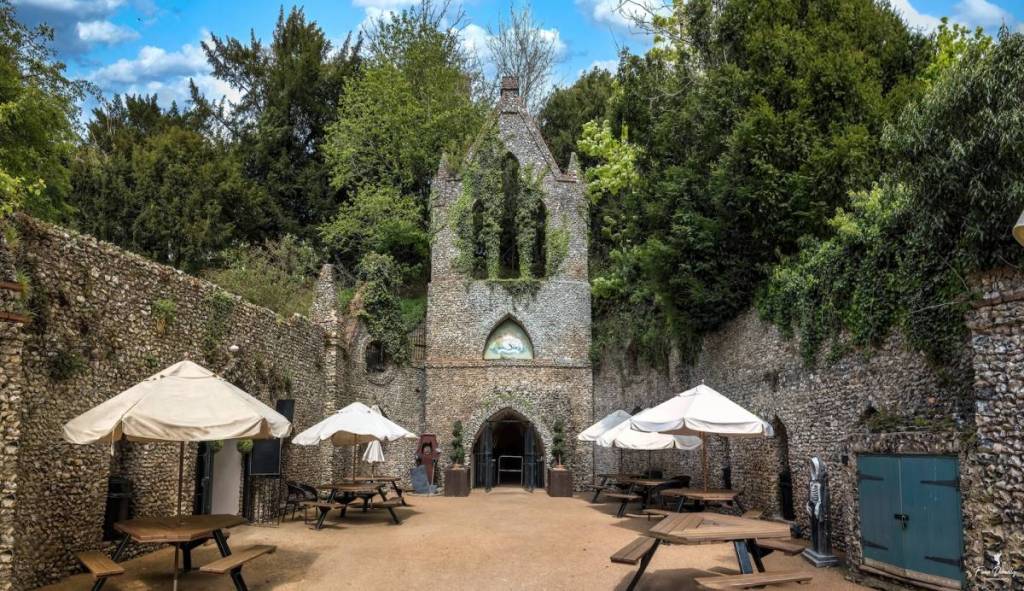

The debaucherous meeting place of a secret society, an unconventional chalk mine, a paranormal hotspot, and a unique gesture of one-upmanship from an 18th-century eccentric, the Hellfire Caves are a historic jack-of-all-trades with a long, storied past and plenty of intriguing theatrical elements. Like the immersive experiences of today, the attraction uses an entertaining fusion of history and interactivity to plunge visitors into creator Sir Francis Dashwood’s myth-inspired world.
Where can you find the Hellfire Caves?
Located at the edge of the Chiltern Hills in Buckinghamshire, only an hour’s drive from London, the caves are found within the West Wycombe Estate. The sprawling 5000 acre land has been home to the Dashwood family for generations and is now co-owned with the National Trust. All the better for us, as it means we can have a nosey around.
It makes for an ideal day trip from the city. One where you can spend the morning perusing the lavish furnishings and gold-framed paintings of the Palladian mansion in West Wycombe Park, before later descending into shadowy tunnels to discover wild tales about the Hellfire Club and pantomimed rituals performed by bored aristocrats. Bookended by stops at the Walled Garden cafe for tea and bakery-fresh treats, of course.
The origins of the Hellfire Caves
Despite it being known as a notorious venue for the hedonistic exploits and mock-religious rituals of high-society rakes, the initial creation of the caves was actually conceived by Sir Dashwood as a way to help local poverty and unemployment during a time of droughts and failed harvests. He employed local workers to dig out chalk from the hill, which could be used to create a new main road between West Wycombe and High Wycombe. Though the question remains: why dig an explicitly designed network of tunnels when he could have just enlarged the quarry? You don’t have to be Sherlock to suspect an ulterior motive. It’s no secret artificial caves were very fashionable at the time, and Sir Francis seemingly liked to keep up with the latest trends.
Once the caves were completed in 1752, Dashwood had his very own underground playground for his exclusive group, which he dubbed ‘Order of the Knights of St. Francis’ (the name ‘Hellfire Club’ was later assigned by the public), and which counted leading politicians, prime ministers, aristocrats and artists among its members. Designed as a hidden escape from the puritanical rules of society, the caves were said to be used for mock religious ceremonies, sexual debauchery, heavy drinking and, no doubt, some shady politics and backroom deals.
Dashwood was also a close friend of Benjamin Franklin, who visited the estate frequently during his stays in London. Though he wasn’t believed to be a member of the Hellfire Club, the Founding Father had visited the caves on occasion, and there’s even a chamber named after him: ‘Franklin’s Cave’.

What can you expect at the caves today?
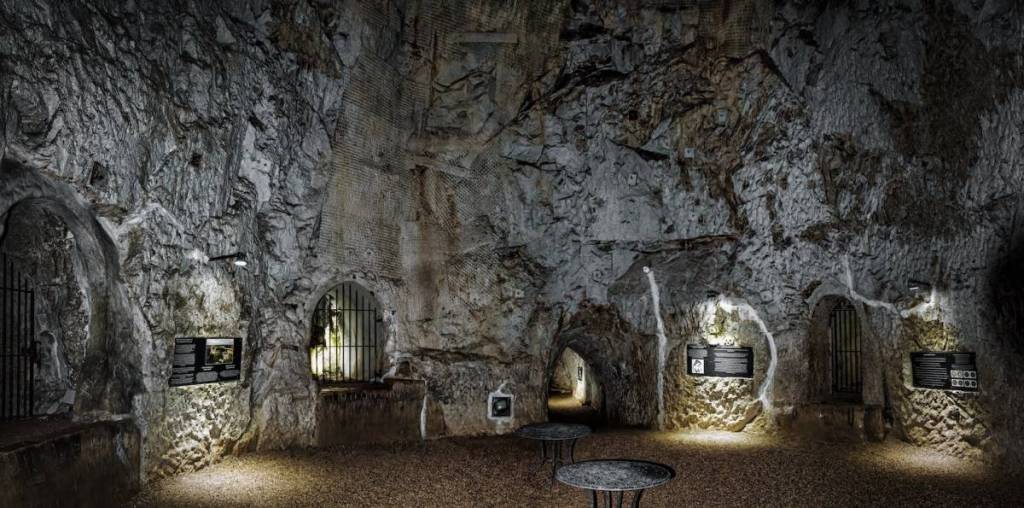
Alas, for those poor aristocrats, all good things must come to an end, and in 1760 the club disbanded. The caves fell into ruin for 150 years, buried in folkloric legend and ghost stories, before eventually being revitalised as a tourist attraction in the early 1950s by a direct descendant of Sir Francis Dashwood – who shared the same name. After the installation of atmospheric lighting, safety measures, waxwork scenes, sound effects and informative placards, the site was restored and has since welcomed over 2.5 million intrigued visitors.
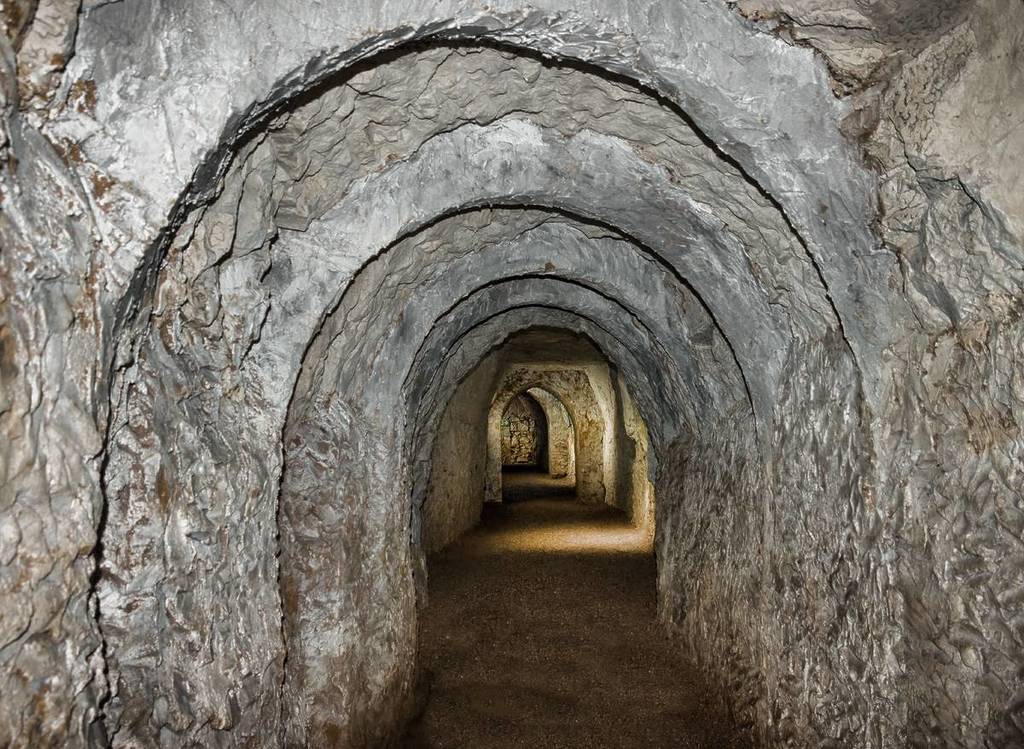
Like any good immersive experience, the caves were designed to play with the senses. If descending 300 feet underground doesn’t quite dial up the shudders, then the dim glow of light and drop in temperature might. In contrast to the narrow winding tunnels, visitors can also expect a slight sensory overload in the booming space of the Grand Banqueting Hall, with echoing acoustics purposefully designed to overwhelm.
Dashwood seemed to delight in the use of spatial illusions, forced perspective and nods to one of his great interests, ancient Greek mythology. This is reflected in his ‘River Styx’, a small stalactite-covered stream in the caves which he named after the mythological river that separates the world of the living and the dead.
You could say he wrote the playbook for the immersive experiences you can visit today. The walkthrough-style design and historic recreations are staple features in numerous interactive London exhibitions – the only difference is the increased use of technology as it has developed. You can see the curiosity-sparking techniques from the Hellfire Caves used in the likes of The Timewalk Exhibition, where you are whisked away to ancient civilisations through sculptures and stunning visuals, and the Paradox Museum London, home to a wonderland of mind-warping illusions.
As seen on screen
It’ll be no surprise that the striking gothic stone facade and eerie tunnels have made the Hellfire Caves a popular filming location. You can even spot the entrance in the 2024 film Beetlejuice Beetlejuice, where it doubled as the entrance to a Romanian Castle. It has also seen the spotlight in the likes of Midsomer Murders, Silent Witness and Little Dorrit.