


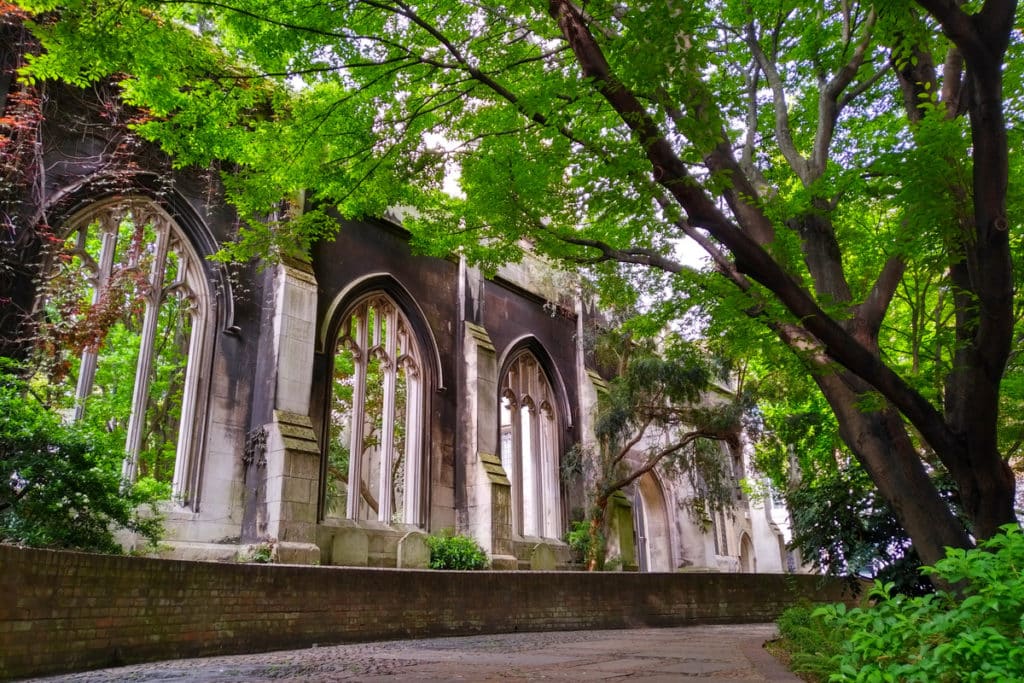
If you’ve ever wandered around the City of London on a weekend, you’ll know it’s an oddly serene place. Freed from the weekly crowd of bankers and hedge fund types, a strange peace descends upon the city. But there’s one place that stands out from the crowd – as beautiful as it is tranquil: the bombed-out ruins of the church of St Dunstan in the East.
The church was named after St Dunstan, a tenth-century monk with a colourful past. He survived brushes with black magic, leprosy, and the Devil himself to become Archbishop of Canterbury. St Dunstan in the East, following the saint’s example, boasts its own difficult history.

St Dunstan’s past
The church has certainly suffered the slings and arrows of outrageous fortune in the nearly 1,000 years it’s been standing. Like much of the City, it was badly damaged by the Great Fire of London. As a consolation prize, it got a new tower built by Sir Christopher Wren. But the misfortunes didn’t stop there. The tower and steeple, along with the north and south walls, are the only parts that still stand today. The rest of the building’s features had been wiped out in 1941 by a German bomb.

Eventually, the Anglican Church was forced to abandon the project when it became too much of a hassle to rebuild. In 1967 the City of London turned the ruins of St Dunstan into a public park, and the Church’s loss became London’s gain. And now I’ve been converted to the cause. I now firmly believe that every park should come with some stunning ruins in the middle.
The park today
Trees grow through windows and vines wind themselves around walls of St Dunstan in the East, whilst palm trees make for a positively tropical addition. All in all, it’s a gorgeously green spot when the sun shines.

Although having said that, grey skies and a dusting of snow make St Dunstan look simply magical. And a blanket of crunchy colourful leaves makes it a haunting must-visit in the autumn too. But let’s not forget about how stunning the spring blooms can make the walls look.
Frankly, any time the sun dapples its walls, St Dunstan shines…

Those with some cash can hire St Dunstan in the East for all sorts of events. And a quick browse through Instagram proves that it’s a stunning spot for a moody photoshoot. But even if you aren’t striking a dramatic pose for your adoring followers, St Dunstan still makes for a lovely day out. Maybe it’s time for you to make a pilgrimage?