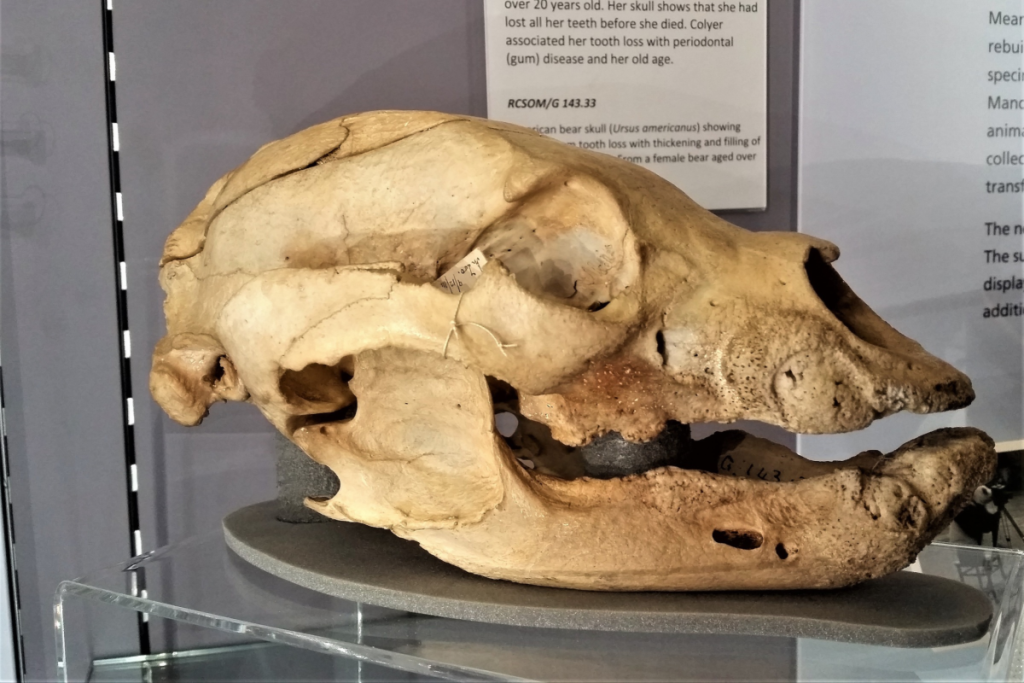

It’s been exactly 100 years since Winnie-the-Pooh first plodded onto the pages of a storybook. And to mark this rather momentous milestone, the skull of the actual bear that inspired the loveable literary character has temporarily gone on display in London.
The bear in question was a black bear named Winnifred (or Winnie among friends) who had been brought over to England from Canada by Lieutenant Harry Colebourn. Winnie lived at London Zoo between 1914 and 1934, and was frequently visited by A.A. Milne and his son, Christopher Robin. It turns out that those very visits would go on to inspire the most beloved bear in fictional history (sorry, Paddington). Because in 1924, Milne published the the first of his classic Winnie-the-Pooh books, with the title character having been inspired by the real-life Winnie.
Winnie lived to be 20 years old, and when she died, ZSL donated her skull to an esteemed dental and maxillofacial surgeon of the time, Sir Frank Colyer. He then passed it on to the Odontological Collection at the Royal College of Surgeons of England. And that’s exactly where the skull has just been put on display. The Hunterian Museum set up shop inside the college in 1813, and is home to a whole hose of anatomical specimens – now including the skull of Winnie. Her skull shows that she had lost all of her teeth. This may well have been due to tooth decay as she supposedly had a rather hefty sweet tooth (much like her fictional namesake), and loved eating condensed milk and treacle.
Winnie’s skull is on display inside the Hunterian Museum at the Royal College of Surgeons of England. The museum is free to visit but you can book in advance here.
📍You’ll find the museum at 38–43 Lincolns Inn Fields, WC2A 3PE.
🚇 The nearest station is Holborn.