Tucked beneath a busy east London roundabout lies one of the capital’s most unexpected design gems.
A Central line station whose barrel-vaulted concourse and symmetrical tile-work look more like a Moscow Metro palace than a Zone 4 commuter stop.
Locals and transport enthusiasts have long nicknamed it “Moscow Hall” for good reason.
The London Tube station that looks straight out of Russia

From street level, Gants Hill is easy to miss. The ticket hall sits under the Gants Hill roundabout in Ilford, reached via pedestrian subways, with no grand façade or surface building to signal what’s below.
But descend the escalators and the space opens into an elongated, barrel-vaulted lower concourse between the two platforms, all clean lines, glowing curves and rhythmic symmetry.
The effect is deliberately cinematic: a delayed reveal that swaps everyday commute for a moment of architectural theatre. It’s the kind of space that makes you slow your pace, look up and actually notice the station rather than just pass through it.
Why this London Tube station looks like the Moscow Metro
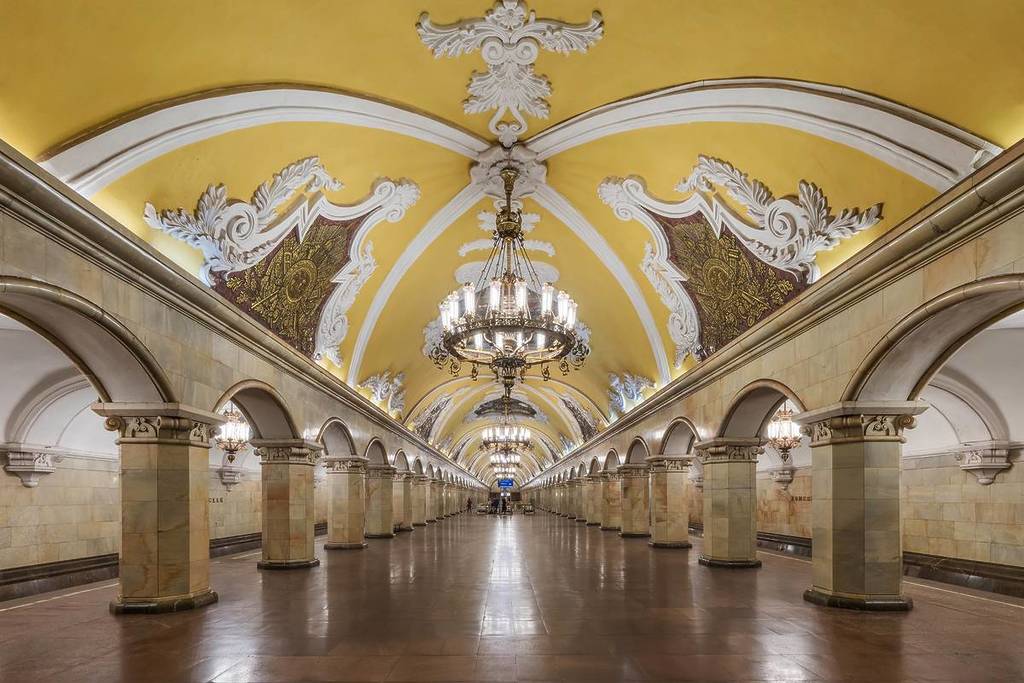
The resemblance isn’t accidental. In the 1930s, the London Passenger Transport Board advised Moscow on building its new Metro system, and Underground engineers studied the Soviet capital’s stations closely.
An internal 1935 report on Moscow’s network helped prompt the decision to create at least one London station in a similar style.
Gants Hill was designed by Charles Holden, the modernist architect behind many of the Underground’s most iconic interwar stations.
Holden had travelled to Moscow as a consultant in the mid-1930s, and the marble corridors, domed ceilings and grand axial layouts he saw there clearly influenced his thinking.
While Gants Hill is more restrained than Moscow’s chandeliered showpieces, its platform-level design echoes stations such as Okhotny Ryad, Krasnye Vorota and Chistyye Prudy on the original 1935 Moscow line.
Architectural writer Joshua Abbott, author of Modernism in Metroland, has described Gants Hill as “unique among Holden’s stations due to its Moscow Metro-influenced platform design and lack of surface buildings.”
A hidden Soviet-inspired treasure in east London
Gants Hill was planned as part of the 1935-40 New Works Programme, which extended the Central line eastwards and created the Hainault loop. Construction began before 1937, with much of the tunnelling completed by 1940, but the Second World War brought work to a halt.
During the conflict, the unfinished station tunnels were used as an air raid shelter and, later, as a secret munitions factory for Plessey, employing around 2,000 people. Work resumed after the war, and Gants Hill finally opened to passengers on 14 December 1947 as part of the Central line extension to Newbury Park.
The only Tube station of its kind in London
Gants Hill stands out in Holden’s portfolio for two main reasons:
No surface buildings: It is the only Holden-designed Underground station with a concourse but no street-level station building. Low structures on the roundabove provide daylight and ventilation, but the architectural drama is entirely underground.
Moscow-style platform concourse: The barrel-vaulted lower hall, with its symmetrical tiling and elongated perspective, is unlike any other Holden station on the network.
The station also features distinctive details such as miniature roundels set into the platform tiles and special roundel clocks, adding to its character. Despite its architectural significance and a local campaign for protection, Gants Hill is not currently Grade II listed, unlike some of Holden’s other stations.
Gants Hill is on the Central line’s Hainault loop, between Redbridge and Newbury Park, in Travelcard Zone 4.