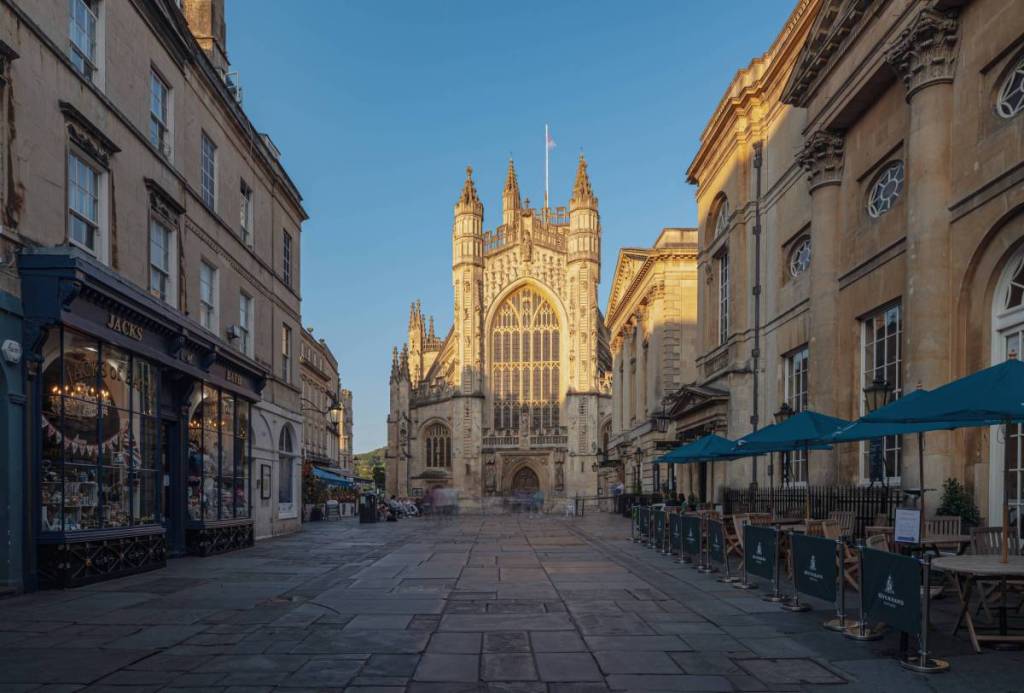

Reached in just over an hour from London Paddington, Bath Abbey is a honey-stone Gothic beauty that’s often called the “Lantern of the West” and has presided over the city for around 500 years. Its history stretches much further back: worship has taken place on this spot for some 1,200 years, and King Edgar’s coronation happened here in 973.
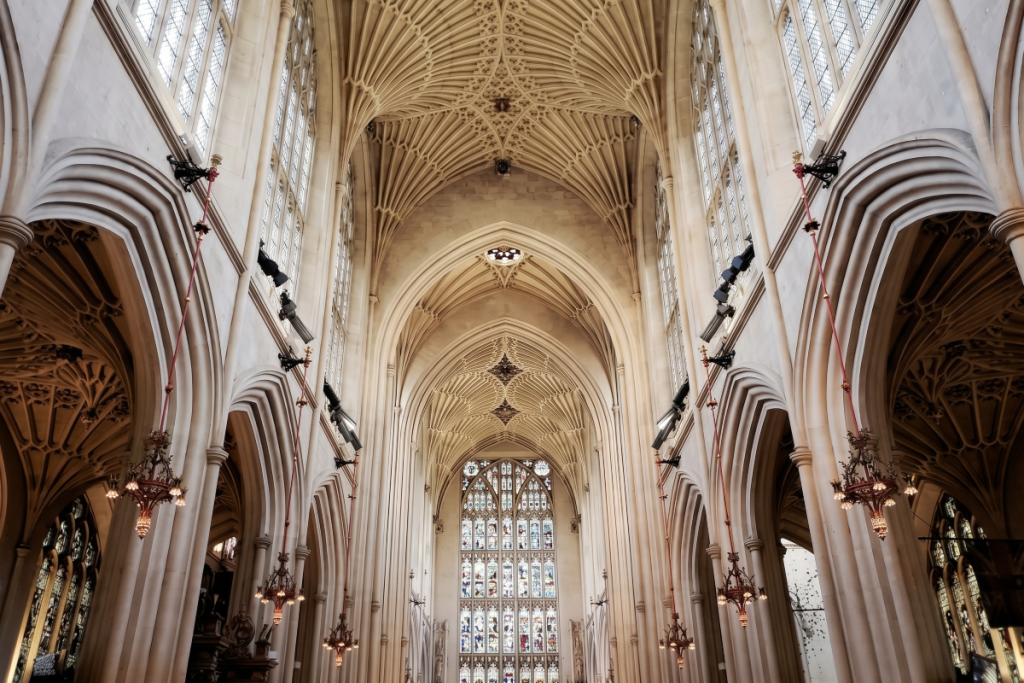
The exterior is just as compelling as the interior, with angels ascending ladders carved into the front—a design linked to a bishop’s vision—while spectacular fan vaulting fills the nave. It is remarkable that the building survives at all: following the Dissolution of the Monasteries in 1539, the Abbey was abandoned and left in serious decline.
It is not just a place to admire from the outside, either. Beneath its soaring fan-vaulted ceiling, amid stained-glass windows and honey-coloured stone, Bath Abbey will host a packed programme of live music over the next few months. Expect opera, organ recitals, Disney concerts, choral performances and festive classics, all under one historic roof.
16 January 2027 19:00
Bath Abbey
What makes Bath Abbey so special?
1. It’s got more than 1,200 years of history
There’s been Christian worship on this site for more than 1,200 years. The earliest record of a convent here dates to 675, and a monastery is mentioned in 757. It was also here, at the earlier Anglo-Saxon Abbey, that King Edgar was crowned King of All England in 973. The ceremony, devised by St Dunstan, Archbishop of Canterbury, established a blueprint for English coronations: its procession, oath, anointing and crowning all survive, in evolved form, in the ceremony today.
2. The “Lantern of the West” is built to catch the light
Bath Abbey is called the “Lantern of the West” because its interior is unusually filled with natural light. Its late-Gothic walls contain 52 large windows, with glass occupying roughly 80% of the available wall space.
3. There are angels climbing ladders on the front
The west front is the Abbey’s showstopper. Carved angels climb ladders up the façade, an image of Jacob’s Ladder from the Bible that, according to tradition, came to King in a dream. It may be legend, but the carvings are very real. Look closer and you’ll spot a crown, an olive tree and a bishop’s mitre, all symbols associated with the bishop. Olive. King. We suspect he enjoyed a pun.
4. The ceiling is two eras in one
Inside, the stone fan vaulting pulls your eye down the length of the church. Robert and William Vertue, builders for Henry VII, began it in the early 1500s, and their vaulting survives in the eastern part of the Abbey. The nave is a different story: George Gilbert Scott‘s restoration, begun in 1863, replaced its wooden ceiling with stone fan vaulting. That’s why the two ends look different, so it’s worth looking up for more than a selfie.
5. It very nearly didn’t survive
After the monks were forced out in 1539 by Henry VIII, the church fell into decay. About 30 years later, the ruined building was handed to the city. Then, in 1573, Queen Elizabeth I licensed a seven-year nationwide collection to pay for its restoration. So the Abbey isn’t just a religious landmark. It’s a civic rescue story, and it’s still a working church today.
6. You can climb the tower
Guided tower tours take you up 212 steps, through the ringing chamber and bell chamber, into the space above the vaulted ceiling and behind the clock face. At the top, you get one of the best views in the city, across Bath and the countryside, down to the Roman Baths and Thermae Bath Spa.
7. The rest of Bath is right outside
The Abbey sits at the centre of the city, close to the Roman Baths, the Pump Room, Pulteney Bridge, the Georgian streets and Thermae Bath Spa. The city has literary and screen credentials too. Bath was home to Jane Austen and features heavily in Northanger Abbey and Persuasion, and it’s been a filming location for the Regency-era Netflix series Bridgerton. If a future visit lands in September, the Jane Austen Festival is an annual fixture.
It’s seriously good for food, as well. The Michelin Guide named Bath among the world’s 10 most exciting foodie destinations of 2025, and we’ve written about why it made the list. Olive Tree at The Queensberry Hotel is still Bath’s only Michelin-starred restaurant, having held its star since 2019, while OAK, on North Parade Passage, is in the guide with a Green Star.
8. It’s got a seriously busy concert calendar
The Abbey isn’t just one for Sunday services. Over the next few months, there’s something on most weeks:
- An Evening of Kate Bush: 9 and 10 October, 7:30pm
- A Night at the Opera by Candlelight: 16 October, 7:30pm
- Tuesdays@1 Organ Recitals: weekly on Tuesdays at 1pm, with organ tours straight after
- WINTER with St Martin’s Voices: 21 November, 7:30pm
- Handel’s Messiah with Bath Choral Society: 4 and 5 December, 7:30pm
- A Christmas Celebration: 12 December, 7pm
If you needed one more excuse, Candlelight: Disney Love Songs is coming to the Abbey too. Picture 15 Disney love songs played live under that fan-vaulted ceiling, from “Can You Feel the Love Tonight” to “Married Life”, with “A Whole New World” somewhere in between. A church begun in 1499 and a magic carpet song. Why not?
This isn’t the full list, of course. But it’s a decent start.

Candlelight: Disney Love Songs
16 January 2027 19:00
Bath Abbey
How to get from London to Bath Abbey
Direct trains from London Paddington reach Bath in around 1 hour 14 minutes, though journey times vary by service. If you’d rather drive, it’s about two and a half hours via the M4. Take a morning train, do the Abbey and the tower, see the Roman Baths, wander the Georgian centre, finish with the Pump Room or the spa, and head back to London in the evening.
Pro tip: if you’re going for the Christmas Market, it’s open 10am–7pm Monday to Wednesday, until 8pm Thursday to Saturday, and until 6pm on Sundays.
📍Address: Abbey Church Yard, Bath, BA1 1LT, United Kingdom.
More things to do in Bath this autumn and winter
As the days feel shorter and the nights get colder, Bath makes for an ideal day trip from London.
This year, Bath Film Festival brings more than 50 films, events and immersive experiences to venues across the city from 16 to 25 October. Then Bath Mozartfest follows from 13 to 21 November, with concerts devoted to Mozart and his contemporaries, before the Bath Christmas Market fills the central streets with chalet stalls, seasonal food and gifts from 26 November to 13 December.
Add Bath on Ice, the open-air rink in Royal Victoria Park, which Visit Bath lists from 10 November to 3 January 2027. The Abbey’s programme also includes seasonal music and carol concerts across November and December, so that’s a strong case for a trip out west.