
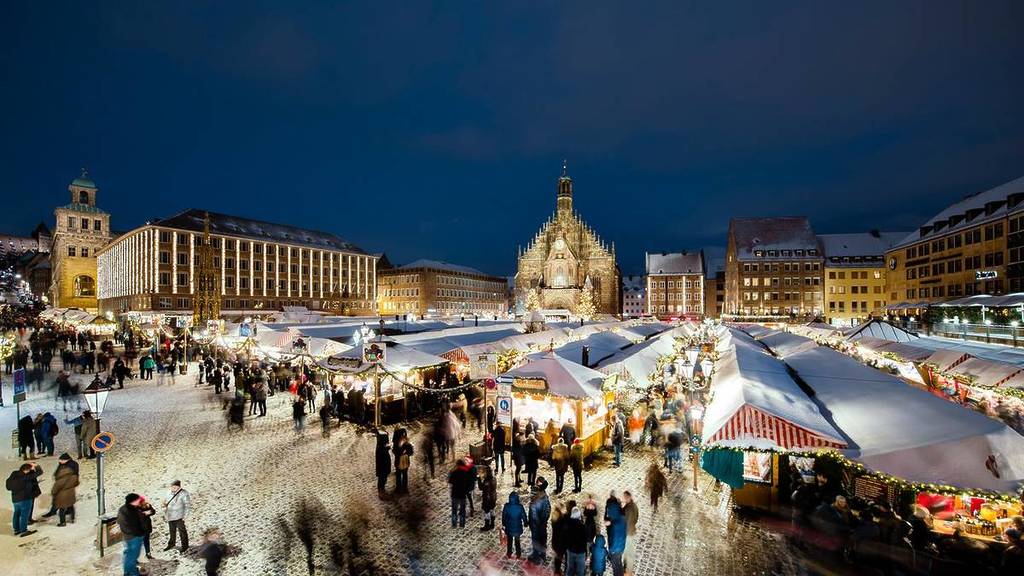

For a festive city break that feels genuinely historic rather than manufactured, one German market stands out.
One of the oldest and world’s best-known Christmas markets
Set in the medieval Old Town of a Bavarian city, it is one of Germany’s oldest and best-known Christmas markets, drawing more than two million visitors each year.
Recommended Articles
 55 truly wonderful things to do in London this November – from ice skating to Christmas markets, theatre festivals, and more
 A magical Christmas market in London has been named one of the best in Britain – and it boasts the UK’s largest open-air ice rink
The market takes over the city’s Main Market Square, beneath a Gothic church and beside an ornate historic fountain.
For a few weeks each Advent, around 180 red-and-white striped wooden stalls transform the square into what locals call the “Little Town of Wood and Cloth.”
Discover Nuremberg’s medieval history and more

This is not a modern invention designed for tourists. Its roots are commonly traced to the 16th century, with the first written mention dating to 1678; an inscribed box from 1628 is also often cited as early evidence of the market.
Its traditions are closely tied to the Protestant Reformation. In Lutheran regions, the gift-bringer became the Christkind, the Christ Child rather than St Nicholas, and that figure remains central to the city’s festive identity.
The market is Nuremberg’s Christkindlesmarkt literally the “Christ Child Market.”
Held in Nuremberg, Germany, it is one of the country’s most storied Christmas markets and a major reason the city becomes a festive destination every winter.
Nuremberg is worth more than a day trip. Its Old Town is enclosed by historic walls and overlooked by the Imperial Castle, while the city’s underground passages offer a different perspective on its medieval past.
Each year, the market opens on the Friday before the first Sunday of Advent. A young woman chosen as the Christkind delivers a ceremonial prologue from the gallery of the Church of Our Lady, officially beginning the season.
Unlike many British Christmas markets, this one retains a strong emphasis on traditional craft and regional food.
Stalls sell handmade decorations, wooden toys, beeswax candles, glass baubles, nutcrackers and the city’s distinctive Zwetschgenmännle small figures made from dried prunes.
The food is equally central to the experience. Visitors come for grilled sausages, roasted almonds, mulled wine and Lebkuchen, the spiced gingerbread for which the city has been famous for centuries.
There is also a dedicated children’s Christmas area nearby, with baking, candle-making, storytelling, rides and a nostalgic fairground.
Getting there from London
The trip is remarkably straightforward for UK travellers. Direct flights from London Heathrow and London Stansted take roughly one hour and 45 minutes, with British Airways and Ryanair operating services during the Christmas-market season.
For 2026, the Christkindlesmarkt runs from 27 November to 24 December, with daily opening hours listed as 10am to 10pm; Christmas Eve has earlier closing arrangements.
