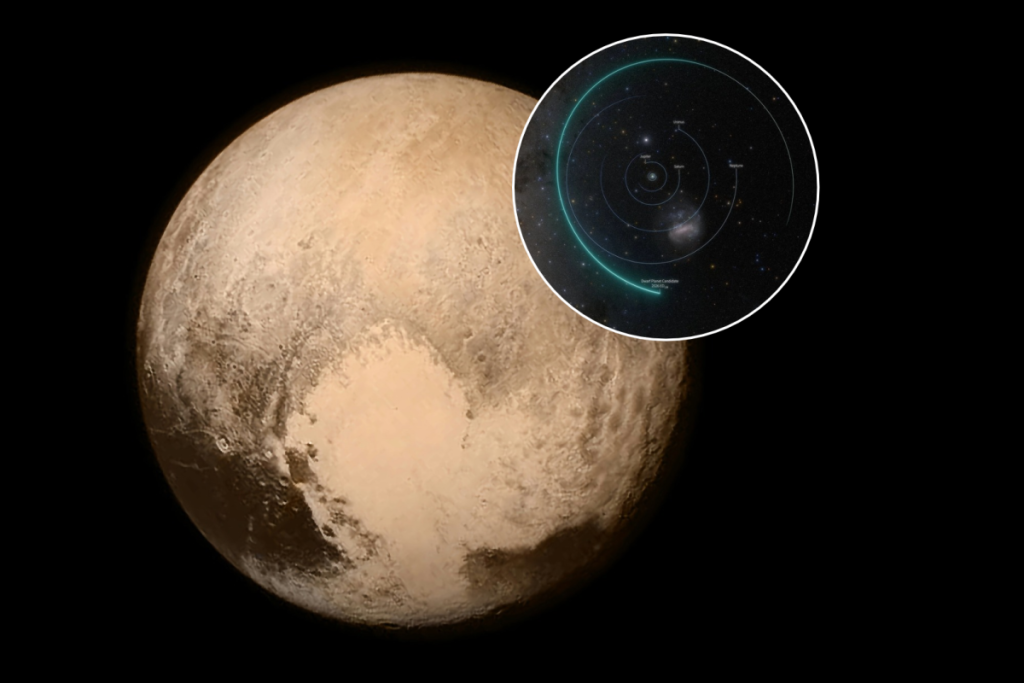

When it comes to our universe, we’ve explored most of it. However, one might think humans have become pretty familiar with our Solar System by now; from the first Moon landing to the Voyager I spacecraft crossing into interstellar space, there have been plenty of opportunities for exploration thanks to advanced science. But it appears the Solar System has plenty of surprises left up its sleeve, as a new dwarf planet has been discovered beyond the orbit of Neptune. What?!
Located around 4.3 billion miles from the Sun (that’s 46 times farther than Earth), a new enigmatic world has been unveiled by astronomers at the Vera C. Rubin Observatory, temporarily named 2026 ED138. The new dwarf planet is estimated to measure between 370 and 930 miles across, and could be the largest object known to date beyond Neptune. In comparison, Pluto is around 751 miles in diameter.
The exact size of 2026 ED138 cannot be accurately determined until scientists figure out how reflective its surface is, which will be done in the coming days and weeks with different telescopes.
The area it was discovered in is a doughnut-shaped region of icy objects beyond Neptune called the Kuiper Belt. 2026 ED138 is not the only thing expected to be located in the region, with some scientists suspecting a potential Planet Nine to be discovered. Overall, astronomers estimate a whopping 32,000 new objects to be discovered in the Kuiper Belt.
According to some astronomers, if it’s there, Planet Nine could be larger than Earth, and smaller thank Neptune.
What is a dwarf planet?
For a celestial object to qualify as a dwarf planet, it must:
- Orbit around its host star.
- It must be mostly round in shape.
- Must be big enough to clear objects of a similar size around its orbit around the host star.
How many dwarf planets are there in the Solar System?
Currently, there are five recognised dwarf planets in the Solar System: Pluto (which was long considered the ninth planet), Ceres, Haumea, Makemake, and Eris.
Paul Byrne, a planetary scientist at the Washington University in St. Louis, said: “This is incredibly exciting. It heralds a new era of solar system and planetary science.”
“This part of the solar system is largely unknown, and every detection such as this brings up a step closer to understanding how ours and planetary systems as a whole came to be.”